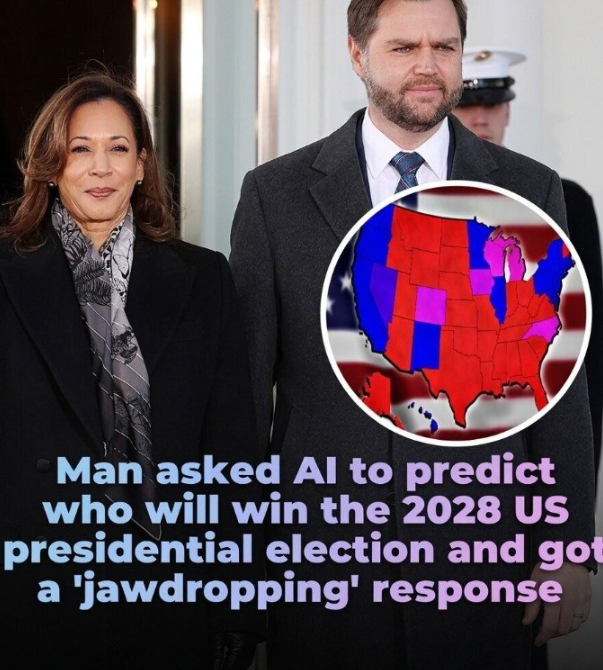
Man Turns to AI for 2028 US Presidential Prediction and Receives a Jaw-Dropping Response, Sparking Shock, Debate, and Curiosity Online, Leaving Viewers Stunned by What the AI Suggested, Raising Questions About Technology, Human Fascination with the Future, and How Far People Will Go to Seek Answers That Might Never Truly Exist
AI 2028 Election Simulation Draws Online Attention
The AI 2028 election simulation has gained attention online after a video appeared on the YouTube channel Election Time. The project was created with help from Grok AI developed by Elon Musk through xAI.
The video presents a hypothetical matchup between Kamala Harris and JD Vance. However, the creators stress that the model explores scenarios rather than predicting real results.
How the AI 2028 Election Simulation Works
The AI 2028 election simulation builds a full Electoral College map using several data sources. These include historical voting patterns, demographic changes, recent election results, and polling information.
Additionally, the system analyzes long-term political trends across U.S. states. Therefore, the simulation produces a potential map showing how electoral votes might shift.
Democratic Primary Field in the Simulation
In the AI 2028 election simulation, Harris leads early Democratic primary support with about 32 percent. Gavin Newsom follows with roughly 23.8 percent support.
Pete Buttigieg appears in a distant third position. Meanwhile, other potential candidates include Alexandria Ocasio-Cortez and Josh Shapiro.
The simulation suggests Harris benefits from strong national recognition. Additionally, her fundraising network and political experience may influence early support.
Republican Field in the AI 2028 Election Simulation
On the Republican side, the AI 2028 election simulation shows Vance dominating early projections. He receives nearly half of the simulated support.
Vance leads several well-known Republican figures in the model. These include Donald Trump Jr., Marco Rubio, and Ron DeSantis.
The model suggests this support would give Vance a strong path toward the nomination. However, the creators note that real elections often change quickly.
Electoral College Map in the Simulation
When constructing the Electoral College map, the simulation first assigns states considered politically stable. These “solid” states are based on long-term voting patterns.
The AI 2028 election simulation shows Vance winning much of the Midwest, Mountain West, and Deep South. The model also treats Ohio as firmly Republican.
Meanwhile, Harris keeps traditional Democratic strongholds. These include California, Washington, and the District of Columbia.
Final Results of the AI 2028 Election Simulation
In the final projection, the AI 2028 election simulation gives Vance 326 electoral votes. Harris receives the remaining electoral votes in the model.
The creators say the simulation highlights how battleground states and demographics influence outcomes. However, they emphasize that unexpected political events can easily change results.
Therefore, the model serves mainly as a scenario analysis tool. It illustrates how different data trends might shape the 2028 presidential race.